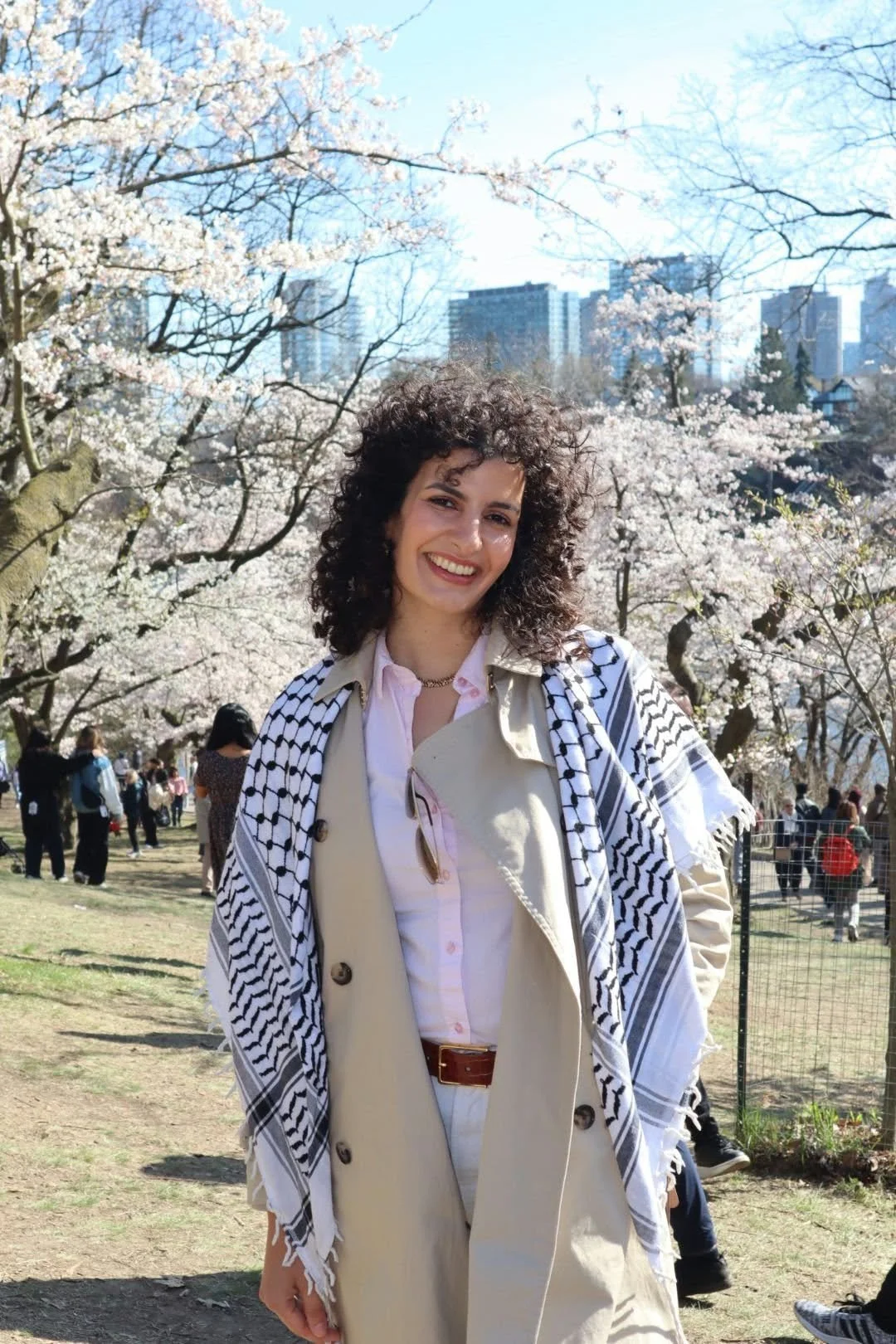
If you’ve been following me on social media, you may have realized that I’ve been less active online for some time. I’ve been making less posts, mainly confining myself to reposting and sharing updates about my village of Madama, south of Nablus. It has been facing increased settler colonial violence since October 2023, along with many other Palestinian villages in the Israeli-occupied West Bank. I’ve been particularly amplifying the posts of Nerdeen Kiswani, a fellow Palestinian female organizer who is not only my birthday twin but a critical thinker and an unrepentant truth teller. She doesn’t flinch from holding accountable politicians and others who are complicit in our oppression as Palestinians, including those who purport to support our cause, even when she adopts positions that are unpopular in our community and among our allies.
Truthfully, I experienced burnout, a slightly embarrassing admission to make for a Palestinian woman whose community continues to face a genocide and is renowned for its sumud (steadfastness). Burnout is defined as “a state of emotional, mental, and often physical exhaustion brought on by prolonged or repeated stress.” I haven’t been subjected to a fraction of the colonial violence my kin in the homeland still face. Yet, they don’t have the luxury to take breaks from their advocacy work, including their struggle to survive. On October 19, 2026, Omar Hamad who is a Palestinian poet and writer based in Gaza tweeted, “I tell myself every day: Don’t die. Don’t get tired. Check on the children. Look for water.” Meanwhile, the journalist Bisan Owda continues pushing for an end to the genocide from Gaza through creative storytelling, movement building, and incisive global-historical analysis.
Yet, it’s absolutely normal for anyone to experience burnout while witnessing the annihilation of their relatives and community members, let alone resisting this injustice within the heart of empire. For two years, I co-organized educational and dabkeh (folkloric dance) workshops, protests, communal events, fundraisers, and more. I had a bag stationed at the door of my house, filled with Palestinian flags, flyers, kuffiyehs, and other essentials, ready to spring into an action if a demonstration was suddenly announced. Around the clock, I made posts on social media that spread awareness regarding the genocide, contextualized Israeli crimes, and outlined steps people could take in solidarity with Palestine. I became an influential voice on X, strategically including “PhD(c)” in my display name in the hope of substantiating my expertise on matters pertaining to my own community, since women of colour are often not treated as legitimate knowledge producers. There weren’t many academics willing to openly speak about the genocide, thus I prominently intervened in public online discourse about it to theorize Zionism as a White supremacist, settler colonial, and Jewish supremacist ideology. At the same time, I was completing my doctoral dissertation on Israeli (green) colonial violence, working as a Teaching Assistant, producing academic publications, and battling repression for my activism. Despite facing massive displacement, erasure, defamation, censorship, torture, and slaughter for nearly 80 years, we as Palestinians are human and not immune from burnout.
When a “ceasefire” was declared in Gaza around the same time that I was awarded a PhD, on October 1, 2025, I allowed myself to acknowledge that I was experiencing burnout, and to take a step back from online and grassroots activism. I use scare quotes here, because it is not possible for a settler colony such as Israel, which is premised upon the perpetual destruction of an Indigenous population, to cease its genocidal, epistemicidal, and ecocidal campaigns. Indeed, Israel has continued bombing Gaza, leading to the martyrdom of hundreds of Palestinians since the announcement of the “ceasefire,” aside from killing, injuring, kidnapping, starving, and expelling Palestinians on a daily basis throughout Historic Palestine. However, the Nakba (Catastrophe), against Palestinians slightly slowed down, bringing some reprieve to us both in the homeland and in exile. We’ve been able to reclaim the bodies of many martyrs who’ve been buried under the rubble, begin processing our emotions, salvage a sliver of normalcy, and reassess our strategies of resistance.
I began exercising again regularly after gaining nearly 10 kg during the genocide, reading books and coordinating a Quran Circle, (a critical reading group), reconnecting with friends, marvelling at local natural beauty, listening to songs that weren’t Palestinian or resistance-based once more, and growing vegetables for the first time. Gardening has allowed me to return to my fellahi (farmer) roots. I reminded myself that one could not pour from an empty cup and that it was important for activists to also take care of themselves.
In the meantime, my online activism never came to a complete halt. Over the last year, I produced content that countered a large defamation campaign directed against the flotilla movement, explained the sudden mass death of Israeli-planted European pine trees, and spoke to the trauma of statelessness. I continued to lead and support local grassroots initiatives too. Certainly, guilt and shame have followed me for not doing more as the bombs kept dropping over Gaza. My fear has also persisted as Israeli settlers and soldiers have increasingly raided Madama, kidnapping, torturing, and killing my relatives, burning our olive trees, and destroying our homes. I’ve learned to sit with these emotions as a Palestinian, empath, and relatively privileged individual living in the Global North.
I’ve been steadily gathering strength to begin contributing more substantially to the Palestinian cause once more. Since I graduated in November 2025, my time and efforts have been greatly devoted towards securing a postdoctoral fellowship, a professorship, or another position in academia where I could achieve some financial stability, and research and teach on a full-time basis, while advocating for the freedom of our community. However, I’ve had to navigate a highly competitive academic job market that is increasingly hostile to the humanities, particularly work that’s unrepentantly anticolonial and abolitionist. Moreover, I identify as an activist-scholar, since my desire to create a better world shapes my research, while my academic outputs inform community organizing and promote progressive societal transformation more broadly. It doesn’t matter greatly that my doctoral research has been cited dozens of times, published in high-ranking journals, incorporated into university syllabi, (across North America, Europe, Palestine, and Turkey), and featured by international news outlets, because racial capitalism is not meritocratic. Rather, universities occupy a central role in upholding this structure, even as intensifying social crises and accelerating climate change pose an existential threat to humanity. I’ve repeatedly and expressly been denied academic opportunities because I wrote about Palestine in ways that didn’t whitewash Zionism or fetishize our culture.
The purpose of this post wasn’t to garner sympathy or praise. I was intending to complete my Master’s research on climate change and greening the Canadian world of work when my late professor who was Jewish, Dr. Carla Lipsig-Mummé, encouraged me to write on Palestine instead. She noted that few Palestinians at the time were pursuing graduate studies in the social sciences and urged me to amplify the voices of my community. I knew the moment that I began writing my Major Research Paper on Israeli colonialism and its socioecological harm that I was sacrificing career advancement for the benefit of the Palestinian cause. I was following in the footsteps of my late mom who was blatantly denied better job opportunities in the United Arab Emirates due to her pro-Palestinian cultural activism as an undergrad. May Allah SWT have mercy on the souls of both of these strong and principled women. Again and again, I would sacrifice career advancement in exchange for participation in a collective liberation struggle, a small price to pay in comparison to our kin who are still being martyred simply for remaining in their homes. As a Muslim, I believe that our ultimate purpose as humans on this earth is to uplift one another and purify our souls. The phrase I’ve thus repeated to Gazan brothers and sisters who have graciously thanked me for my smallest acts of service, which has been popularized by the artist Macklemore, is “la shukr a’la wajib” or “there is no thanks for a duty.”
I also believe that Allah SWT opens doors for those who strive for justice. Indeed, over the past year, I’ve received invitations to contribute to multiple volumes and a special issue, continued to be interviewed and invited to deliver lectures, and begun receiving clients for editing, consultation, and academic writing support services after launching my website. Even if I don’t secure a job in Western academia any time soon, we as the wretched of the earth continue to live and speak out. We still use every tool at our disposal to ensure that settler colonialism as a genocidal structure is abolished not only in Palestine but Turtle Island and other parts of the world, ushering in an era of societal and ecological healing.
More than anything, I sought to be a little vulnerable in this post, humanize myself and my community, and share a glimpse of what it is like for me and many other Palestinians and allies to bear witness to the genocide from afar while resisting from a highly complicit state — one which proclaims itself to be free and democratic. The ongoing Holocaust against Palestine has exposed Western hypocrisy, immorality, and tyranny in academia and beyond. Perhaps this entry also motivates readers to mobilize their capacities, skills, privileges, and lived experiences to ease human suffering worldwide, while attempting to not neglect their health and wellbeing. Indeed, that Gazans are continuing to study, marry, have children, work out, and innovate, despite all odds, is deeply inspiring.
This post launches a blog where I am eager to share more long-form content, from personal reflections such as this one, to anti-oppressive commentary on global developments, to reviews of anticolonial films and books. I thank you for taking time to read this entry and being part of this journey, and look forward to engaging in conversation with you all.